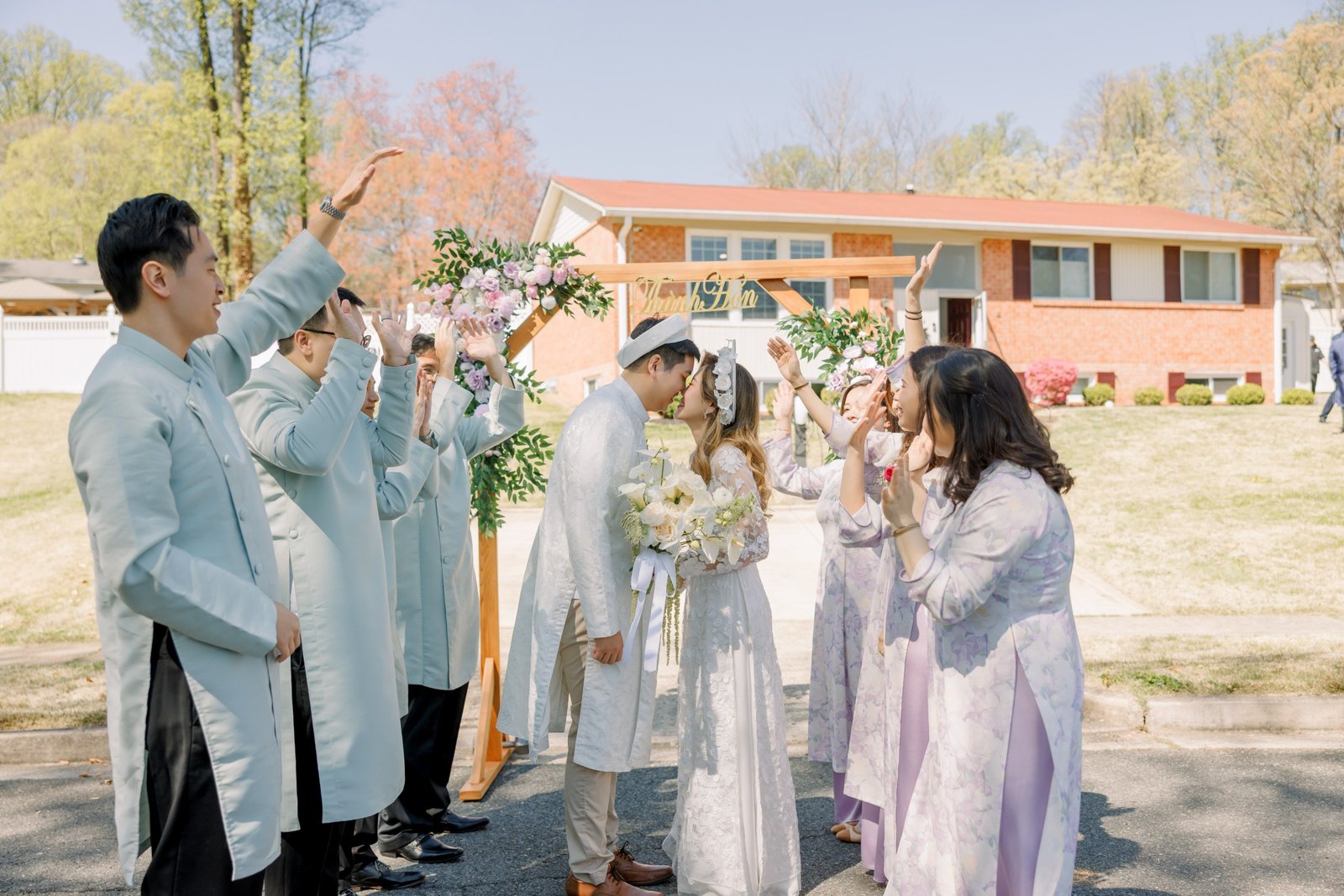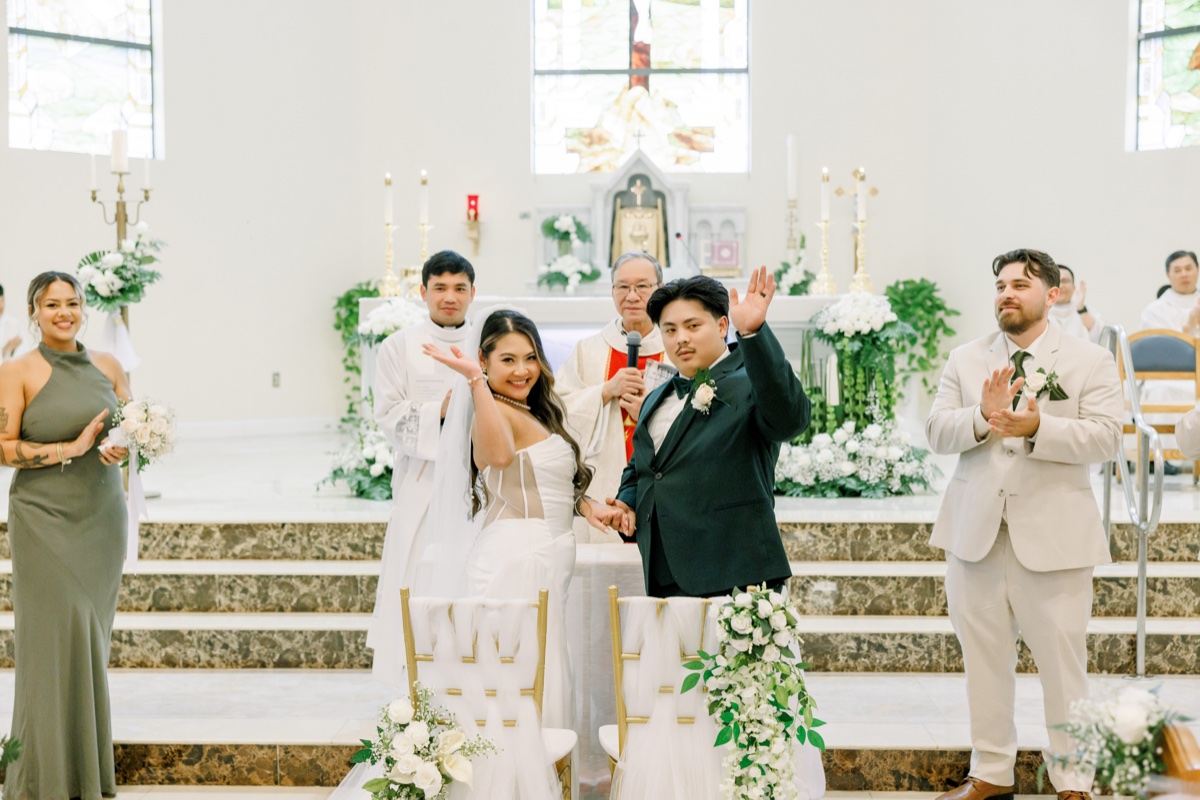
A Vietnamese Catholic wedding is really two weddings in one day. There is the lễ gia tiên — the morning tea ceremony at the family home, where the couple bows before the ancestral altar and honors their parents — and there is the Nuptial Mass, the sacred Catholic liturgy at church that joins them before God. Photographing both well takes more than a good camera. It takes someone who understands the rhythm of each, speaks the language of the family, and knows when to step forward and when to disappear.
I am Kim Nguyễn — Kevin Socola — a Vietnamese-born wedding photographer based in Fairfax, VA. Over more than a decade and 500+ weddings across the DMV, Vietnamese Catholic weddings have become some of my most meaningful work. This guide is for couples planning one, and for families who want to understand what a photographer should be doing on the day.
Key Takeaways
- A Vietnamese Catholic wedding usually spans three events in one day: tea ceremony, Nuptial Mass, and reception
- Most churches restrict flash and sanctuary access during Mass — low-light camera skill matters more than gear
- A bilingual photographer keeps family portraits and the tea ceremony calm and inclusive for elders
- Build a timeline with generous buffer — Vietnamese Catholic days run long and travel between venues adds up
- Book 9–14 months ahead for popular DMV dates
Why a Vietnamese Catholic Wedding Needs a Specialist
Many photographers can shoot a beautiful church wedding. Fewer understand what happens before the church — the incense at the family altar, the order in which elders are honored, the meaning behind the áo dài and the red ceremonial gifts. And fewer still can direct a room full of Vietnamese-speaking relatives without an awkward translator in the middle of an emotional moment.
When you hire a photographer who has documented Vietnamese Catholic weddings before, you are not just buying photos. You are buying someone who already knows that the groom's family arrives in a specific order, that grandparents are honored before parents, and that the priest will likely ask the photographer to stay behind a certain line during the consecration. That knowledge is what keeps the day flowing — and keeps you in the moment instead of managing your vendors.
The best wedding photos of a Vietnamese Catholic day are never staged. They happen because the photographer already knew they were coming. — Kim Nguyễn, Kevin Socola Films
The Two Ceremonies — Lễ Gia Tiên and the Nuptial Mass
Understanding how the cultural and religious halves fit together is the foundation of a good timeline.
The morning: Lễ Gia Tiên
The tea ceremony typically takes place at the bride's or groom's family home in the morning. The couple offers tea to parents and grandparents, bows at the ancestral altar, and receives blessings and gifts. It is intimate, warm, and often the most emotional part of the day. Lighting indoors can be tricky — these rooms are small and the windows are limited — so a photographer who can work with available light and subtle fill is essential.
The church: The Nuptial Mass
The Catholic Nuptial Mass is a full liturgy, usually lasting an hour or more, with readings, vows, the exchange of rings, and often Communion. It is solemn and structured. Unlike a secular ceremony, the priest — not the couple or the planner — sets the rules for photography, and those rules vary by parish. Respecting them is not optional; it is part of being trusted to be there at all.
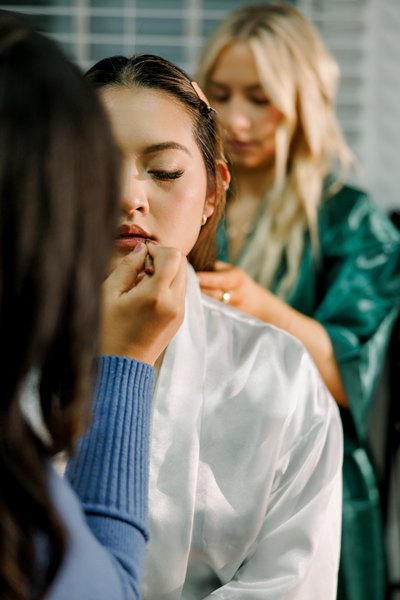
Church Etiquette — What Photographers Must Know
Every parish in the DMV has its own photography policy, and the smoothest weddings happen when the photographer confirms it in advance. Here is what we always check with the priest or coordinator before the Mass:
- Flash policy — most churches prohibit flash during the liturgy
- Sanctuary access — many ask photographers to stay out of the altar area
- Movement limits — some allow free movement, others ask you to stay in one or two positions
- The consecration — often a no-photography moment out of reverence
- Dress code — photographers are expected to dress respectfully for a place of worship
This is exactly why low-light skill matters more than any single piece of equipment. We shoot with fast prime lenses and cameras built to perform at high ISO, so we can capture the vows and the ring exchange beautifully — without a single disruptive flash.
Building the Timeline for a Long Day
A Vietnamese Catholic wedding is one of the longest wedding days you can plan. Three events, often in three locations, with travel and traffic between them. The single biggest mistake couples make is underestimating how much time the day needs. Here is a realistic sample DMV timeline:
- 7:00–8:30 AM — Getting ready, áo dài details, first-look prep
- 9:00–10:30 AM — Lễ gia tiên tea ceremony at the family home
- 11:00 AM–12:00 PM — Travel and buffer time
- 1:00–2:15 PM — Nuptial Mass at church
- 2:30–3:30 PM — Family and bridal party portraits
- 4:00–5:30 PM — Golden-hour couple portraits
- 6:00 PM onward — Reception, toasts, and dancing
Because the day so often runs past eight hours, this is the kind of wedding where a second photographer earns its place — one to stay with the couple, one to cover family and candid moments you would otherwise miss.
The Shot List for a Vietnamese Catholic Wedding
These are the moments we make sure never slip by:
- Incense lit at the ancestral altar
- The couple bowing before parents and grandparents
- Tea offered and received, with elders' expressions
- Close-ups of the áo dài and red ceremonial gifts
- The bride's entrance and the groom's first look in church
- The exchange of vows and rings during the Mass
- The lighting of the unity candle, where the parish allows
- Communion and the priest's final blessing
- The recessional and the couple's first steps as newlyweds
- Multi-generational family portraits — Vietnamese and Catholic sides together
- Golden-hour portraits of the couple alone
- Candid reception moments — toasts, tears, and dancing
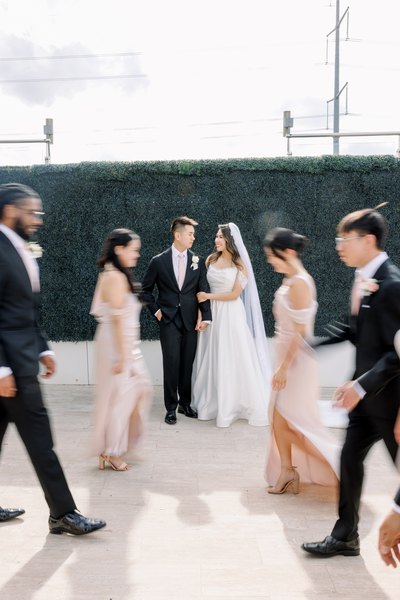
The Bilingual Advantage
The part families remember most is how relaxed the day felt. When I gather three generations for a family portrait and call out directions in Vietnamese, the elders smile instead of looking confused. When a grandmother wants a specific photo at the altar, she can simply tell me. There is no translator standing between the moment and the camera. That ease shows up in the photographs — in genuine expressions rather than polite, stiff ones.
If you are planning a Vietnamese Catholic wedding anywhere in the DMV — Fairfax, Arlington, Falls Church, DC, the Maryland suburbs, or down toward Hampton Roads — I would be honored to talk with you about it, in English or Vietnamese. You can reach me at info@kevinsocolafilms.com or call (301) 246-0806.
About Kevin Socola Films: Kevin Socola (Kim Nguyễn) is a bilingual Vietnamese-American wedding photographer and videographer based in Fairfax, VA, serving the DMV — DC, Maryland, and Northern Virginia. With 10+ years of experience and 500+ weddings captured, Kevin brings cinematic storytelling, cultural sensitivity, and fast 24-hour turnaround to every couple. Packages start at $3,000. View packages →